Introduction
Local SEO ranking factors are the signals Google uses to determine which businesses appear in local search results and Google Maps. Every time someone searches for a nearby service, Google evaluates a wide range of information before deciding which businesses are most relevant to display.
Many business owners assume there is a single ranking factor that determines success. In reality, Local SEO relies on a combination of accurate business information, a well-optimized website, a complete Google Business Profile, customer reviews, local relevance, technical SEO, and overall online credibility.
Because these signals work together, improving only one area rarely produces long-term results. Businesses that consistently maintain their online presence are generally in a stronger position to improve local visibility over time.
In this guide, we'll explain the most important Local SEO ranking factors, how they influence search visibility, and where businesses should focus their efforts.
What Are Local SEO Ranking Factors?
Local SEO ranking factors are the different signals Google uses to understand whether a business is a good match for a local search.
These signals help Google answer questions such as:
- What services does the business provide?
- Where does the business operate?
- Is the information accurate?
- Does the business appear trustworthy?
- Will this result satisfy the user's search?
Rather than depending on one factor alone, Google compares many signals together before displaying local search results.
Businesses should think of Local SEO as building trust across multiple areas instead of trying to optimize a single page or profile.
 Local SEO Wiser
How Google Evaluates Local Businesses
Google gathers information from several trusted sources to better understand a business.
These sources may include:
- Google Business Profile
- Business website
- Customer reviews
- Local citations
- Structured data
- Business directories
- Internal website content
- External links
- Public business information
Google compares this information to check for consistency and relevance.
When details match across multiple sources, search engines have greater confidence in the accuracy of the business.
Conflicting addresses, different phone numbers, or outdated information can make it more difficult to understand which information should be trusted.
Relevance
Relevance measures how closely a business matches the intent of a search.
For example, someone searching for an emergency plumber expects results that clearly provide plumbing services rather than general home maintenance.
Google evaluates relevance using several signals, including:
- Business categories
- Website content
- Service pages
- Business description
- Structured data
- Service information
- Search intent
Businesses should describe their services clearly using natural language rather than repeating the same keywords throughout the page.
Distance
Distance refers to how close a business is to the location connected with the search.
Google may estimate this location using:
- The searcher's current location
- The city included in the search
- Google Maps location settings
- The business address
- Service area information
Businesses cannot control where customers search from, but they can ensure that their business information accurately reflects the locations they genuinely serve.
Prominence
Prominence describes how established and well-known a business appears online.
Several factors may contribute to prominence, including:
- Customer reviews
- Business mentions
- Local citations
- Website quality
- Backlinks
- Business history
- Helpful content
Prominence develops over time through consistent business activity and customer engagement.
Businesses should avoid shortcuts such as fake reviews or artificial link building, as these do not create lasting trust.
Google Business Profile Signals
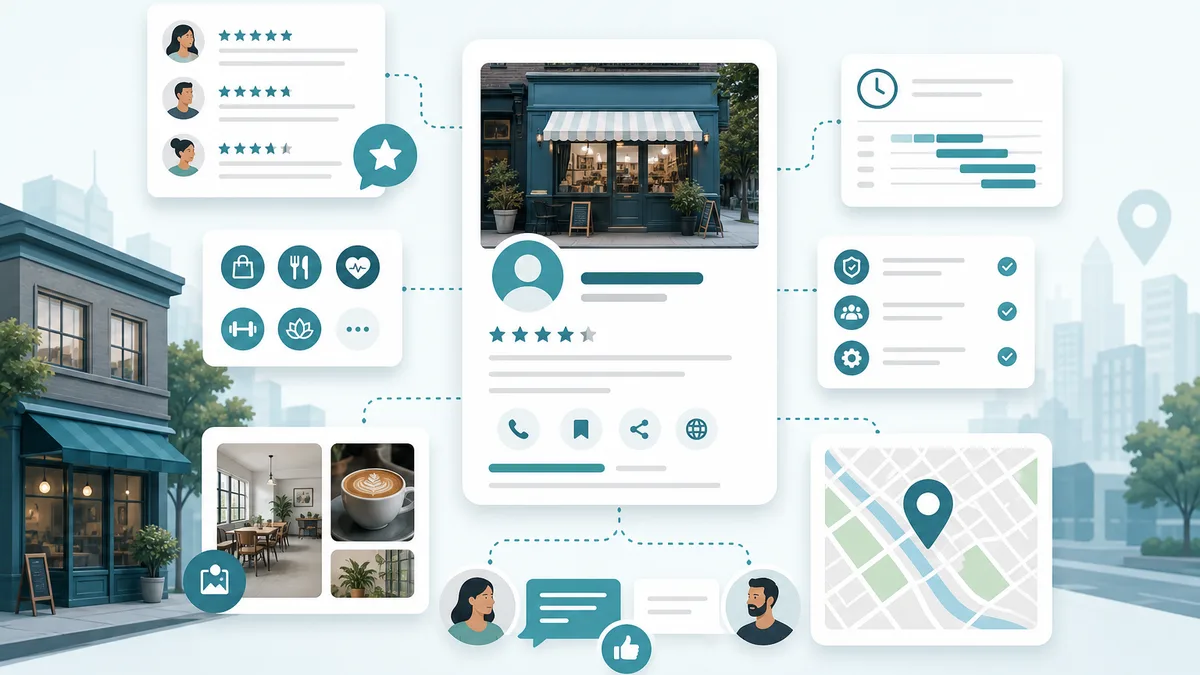
A complete and well-maintained Google Business Profile helps search engines understand a business more clearly.
Important profile signals include:
- Correct business name
- Primary category
- Secondary categories
- Business description
- Services
- Business hours
- Address or service area
- Website
- Phone number
- Photos
- Customer reviews
The profile should accurately reflect the real business rather than being filled with unnecessary keywords.
Profile Completeness
Businesses should complete every relevant section of their profile where possible.
Accurate information improves the customer experience and gives Google a better understanding of the business.
Profile Maintenance
A Business Profile should not be treated as a one-time setup.
Regular updates to business hours, services, photos, and company information help keep the profile accurate over time.
 Local SEO Wiser
Website Quality Signals
Your website supports nearly every aspect of Local SEO.
Google evaluates whether your website provides useful, trustworthy, and accessible information for visitors.
A strong local website usually contains:
- Service pages
- Location pages
- Contact information
- About page
- Helpful articles
- Clear navigation
- Mobile-friendly design
The goal is to help visitors quickly understand the business and take the next step.
User Experience
Visitors should be able to find information without difficulty.
Good user experience includes:
- Fast loading pages
- Easy navigation
- Readable content
- Mobile responsiveness
- Clear calls to action
A confusing website can reduce customer confidence even if the business appears in search results.
 Local SEO Wiser
On-Page SEO Signals
Each important page should clearly explain its purpose.
Useful on-page optimization includes:
- Descriptive page titles
- Helpful headings
- Natural keyword usage
- Internal linking
- Image alt text
- Relevant metadata
Optimization should improve clarity rather than simply increasing keyword usage.
Local Content Signals
Helpful content demonstrates expertise and supports local relevance.
Examples include:
- Service guides
- Location pages
- Local FAQs
- Educational articles
- Industry resources
Businesses should publish content that answers genuine customer questions instead of creating multiple pages that repeat the same information.
Customer Review Signals
Reviews influence both customer decisions and Google's understanding of a business.
Businesses should encourage honest feedback from genuine customers.
Important review considerations include:
- Review quality
- Review freshness
- Response quality
- Overall consistency
Businesses should avoid purchasing reviews or attempting to manipulate customer feedback.
Citation Signals
Citations are mentions of your business information across trusted websites.
Common citation sources include:
- Business directories
- Industry associations
- Local organisations
- Chamber of Commerce websites
The information should remain accurate and consistent across every listing.
Old phone numbers, incorrect addresses, and duplicate listings should be corrected whenever possible.
Backlink Signals
Backlinks remain an important authority signal.
Quality matters much more than quantity.
Useful backlink opportunities include:
- Local news
- Community websites
- Industry organisations
- Local sponsorships
- Professional partnerships
Businesses should earn links naturally through useful content and genuine relationships.
Technical SEO Signals
Technical SEO helps search engines crawl and understand your website efficiently.
Important areas include:
- HTTPS
- Mobile usability
- XML Sitemap
- Robots.txt
- Structured data
- Core Web Vitals
- Canonical URLs
- Broken links
- Image optimisation
Technical improvements should support both visitors and search engines.
 Local SEO Wiser
Behavioral Signals
Google also observes how users interact with businesses after discovering them.
While individual behaviour signals are not fully disclosed, businesses should focus on providing a positive customer experience.
Examples include:
- Helpful website content
- Easy navigation
- Accurate business information
- Fast-loading pages
- Professional customer service
Satisfied customers are more likely to engage with the business, leave reviews, and return in the future.
Common Ranking Mistakes
Businesses often limit their Local SEO performance by making avoidable mistakes.
Common issues include:
- Incomplete Business Profiles
- Inconsistent contact information
- Duplicate location pages
- Keyword stuffing
- Poor website usability
- Fake reviews
- Ignoring technical SEO
- Outdated business information
- Thin content
- Low-quality backlinks
Avoiding these problems creates a stronger foundation for sustainable Local SEO.